Conditions · Body · Breakouts

Back & Body Acne (Truncal Acne)

Medically reviewed by Dr Sin Yong · Last reviewed · 10 min read · Assessed personally by Dr Sin Yong · Jump to questions

Acne on the back, chest and shoulders is the neglected half of the disease: present in roughly half of facial-acne patients, less discussed, harder to reach, slower to treat — and more likely to leave the marks that matter, because truncal skin scars and pigments more stubbornly than the face. It also hosts the great impostor: fungal folliculitis that no acne product touches.

WhatsApp Dr Sin Yong →
Invited by Device Makers to Share His Expertise
International KOL for 14+ device brandsShared his clinical expertise with 500+ doctors across AsiaMBBS (NUS) · MRCS (Edinburgh) · MSc with Distinction (Queen Mary, London) · MSc (Cardiff)Every assessment personally by Dr Sin Yong

Back and body acne (truncal acne) is acne on the back, chest and shoulders, where larger, denser oil glands, thicker skin and constant occlusion from clothing and sweat shape how it behaves. Assessment starts by separating true acne from Malassezia (fungal) folliculitis, because the two look alike but need different treatment.

In brief
  • Back and body acne affects the back, chest and shoulders, shaped by larger oil glands, thicker skin and clothing occlusion.
  • It must be separated from Malassezia (fungal) folliculitis, which looks alike, itches and does not respond to acne treatment.
  • Truncal skin is prone to keloid and hypertrophic scars, and post-inflammatory marks linger longer than on the face.
Key takeaways
  • Back and body acne affects the back, chest and shoulders, shaped by larger oil glands, thicker skin and clothing occlusion.
  • It must be separated from Malassezia (fungal) folliculitis, which looks alike, itches, and does not respond to acne treatment.
  • Truncal skin is prone to keloid and hypertrophic scars, and post-inflammatory marks tend to linger longer than on the face.
  • Management follows consensus recommendations: wash-format topicals, topical retinoids and earlier systemic therapy where disease is moderate to severe.
  • Scrubbing, harsh soaps and long-term antibiotics alone do not address the cause and can make matters worse.

Key Facts

How common
Roughly half of facial acne patients also carry truncal lesions — most never mention it to anyone
Why the trunk is different
Dense, large sebaceous follicles; thicker skin; constant occlusion by clothing, straps and sweat
The scarring stakes
Truncal skin is keloid- and hypertrophic-prone — chest and shoulders lead the raised-scar statistics
The impostor
Uniform itchy bumps that ignore acne treatment are often Malassezia (fungal) folliculitis
Climate factor
Heat, humidity and gym occlusion — Singapore's baseline — drive both true and fungal breakouts
Evidence base
Consensus panels support topical foundations plus systemic therapy for moderate-severe truncal disease
Who assesses this
A physician — bacterial vs fungal decides everything
Typical first step
Organism diagnosis; half of failed back-acne stories treated the wrong one

What does back and body acne look like?
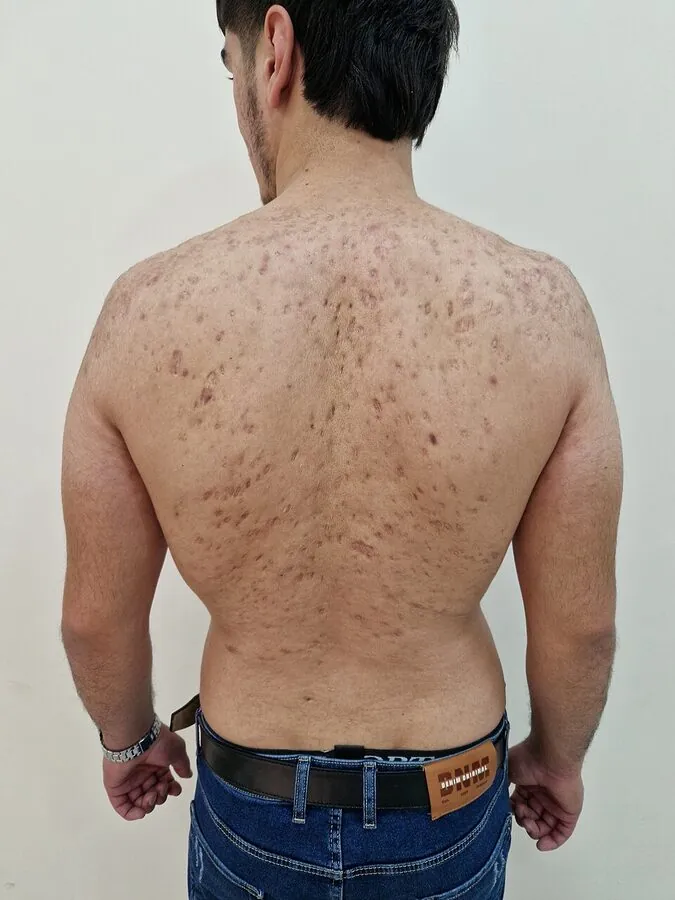
Truncal (back) acne with active lesions and post-acne marks
Truncal (back) acne with active lesions and post-acne marks. Image: Sedef94, via Wikimedia Commons (CC BY-SA 4.0).
Acne involving the face, chest and back
Acne involving the face, chest and back. Image: Wikimedia contributor, via Wikimedia Commons (Public domain).

Why does the back break out — and scar harder?

The truncal reviews describe a follicular landscape different from the face: larger, denser sebaceous units set in thicker skin, occluded daily by clothing and — in a gym-going, tropical population — hours of sweat-soaked compression wear [1]. The same reviews flag the asymmetric stakes: the chest, shoulders and upper back are the body's most keloid-prone territory, and truncal post-inflammatory pigment outlasts its facial cousin. A backne cycle tolerated for years often bills its cost in permanent raised or pigmented marks that the acne itself never warned about.

Acne, fungal folliculitis, or both?

The trunk hosts the classic impostor. True acne is polymorphic — comedones, papules, pustules and deeper lesions of mixed ages. Malassezia folliculitis is monomorphic — crops of near-identical, often itchy bumps across the upper back, chest and shoulders — and it laughs at benzoyl peroxide while worsening under oral antibiotics. The two frequently coexist in the same patient, which is why a trunk that has defeated years of acne products deserves a diagnosis before another product: half the failure stories are simply the wrong organism.

What actually works for back acne?

The consensus recommendations for truncal acne support the same evidence architecture as facial disease, adapted for acreage [2]: wash-format topicals (benzoyl peroxide washes suit large surfaces), topical retinoids in trunk-practical formats, and earlier escalation to systemic therapy — antibiotic courses in defined roles, hormonal therapy where the pattern indicates, and isotretinoin for severe or scarring disease — because reach and adherence limit what creams achieve across a back. In-clinic, the back acne programme adds laser- and light-based control of active lesions, with the acne programme covering the medical arm; leftover marks are triaged between PIH and true scarring. Habits earn their keep here: showering out of sweaty kit promptly, breathable fabrics, and not scrubbing.

What doesn't work for back acne?

Scrubbing brushes and loofahs on inflamed follicles — mechanical insult on a field already inflamed. Harsh soaps 'to dry it out' — barrier damage without follicular effect. Antibiotics alone, indefinitely — resistance and the fungal-overgrowth trap. Sunbathing the back clear — a temporary blur bought with pigment risk on PIH-prone skin. And ignoring it because nobody sees it — the trunk is exactly where quiet acne leaves loud, keloid-shaped receipts.

“Back acne is the quiet half of the disease with the loudest scars — the chest and shoulders forgive breakouts worst of anywhere on the body.”

— Dr Sin Yong

Dr Sin Yong’s Viewpoint

Back acne is the quiet half of the disease with the loudest scars — the chest and shoulders keloid more readily than anywhere else. Half the failed bacne stories I hear were treating the wrong organism entirely; fungal folliculitis shrugs at every acne wash. Diagnose the trunk before buying a fourth product for it.

Prefer Not to Use WhatsApp?

Use the short enquiry form instead →

Leave your name, mobile number and email and the clinic will contact you directly. No obligation.

Your details are delivered directly to Dr Sin Yong's clinic team.

Thank you — your enquiry has been received. The clinic will contact you during opening hours (Mon–Fri 10am–8pm, Sat 11am–3pm).

Prefer a preliminary view first? You can also WhatsApp a photo of the area for Dr Sin Yong to review before you decide on a visit.

Which type do you have?

Truncal acne, fungal folliculitis and the marks they leave
Type / look-alikeHow to recognise itWhat it needsWhat does not work
True truncal acne (polymorphic)Mixed comedones, papules, pustules and deeper lesions of different agesWash-format topicals, retinoids; systemic therapy if moderate to severeScrubbing, harsh drying soaps, sunbathing
Malassezia (fungal) folliculitis (look-alike)Crops of near-identical, often itchy bumps on upper back, chest, shouldersOrganism diagnosis and antifungal treatmentBenzoyl peroxide, or antibiotics alone
Mixed acne and fungal folliculitisBoth patterns together; failure of years of acne productsDiagnosis of both, then treatment of eachAnother acne product without a diagnosis
Post-inflammatory marks (flat pigment)Flat brown or red marks left after spots settleControl of active spots, sun protection and reviewAggressive scrubbing or sun exposure
Raised or keloid scarsFirm, raised scars on chest, shoulders or upper backEarly assessment and scar-directed treatmentIgnoring it because nobody sees it

What does not work, and why

When to see a doctor

Myths we hear in clinic

“Back acne comes from the gym or from poor hygiene.”

Occlusion and sweat contribute, but the cause is follicular; scrubbing harder worsens inflammation rather than helping.

“Any back breakout is acne and a stronger body wash will settle it.”

Uniform itchy bumps are often fungal folliculitis, which does not respond to acne washes.

Questions Patients Actually Ask

Why do I get back acne when my face is clear?+

The trunk's follicles are their own ecosystem — larger sebaceous units, thicker skin and clothing occlusion. Plenty of patients express the disease in one territory only.

Is my back acne from the gym?+

Sweat-soaked compression wear and shared equipment aggravate both true acne and fungal folliculitis. Prompt post-workout showers and breathable kit measurably help; they rarely suffice alone.

Why doesn't my body wash work?+

Either the disease needs more than topicals — a common truth across a back's acreage — or the bumps are fungal folliculitis, which no acne wash treats. Diagnosis beats a fourth product.

Do back acne scars go away?+

Pigmented flat marks fade over months and respond to PIH treatment. Raised chest and shoulder scars are keloid-family — permanent without targeted treatment, and the reason truncal acne deserves earlier control.

Should I take antibiotics for it?+

Defined courses have a role within a plan — but antibiotics alone, open-endedly, invite resistance and fungal overgrowth. Severe or scarring truncal disease often warrants the isotretinoin conversation instead.

Can I treat back acne and the marks at once?+

Control first, marks second — active disease keeps printing new marks behind every treatment. The sequencing protects both results.

What causes back and body acne?+
The trunk has larger, denser oil glands set in thicker skin, and clothing, straps and sweat occlude it daily, which is common with gym wear in a humid climate. Heat and humidity drive both true acne and fungal folliculitis. Hormones and family tendency can contribute, and the two conditions often coexist, so diagnosis comes first.
Can back and body acne be cured?+
Acne is controlled rather than cured, and no outcome can be promised. Consensus recommendations support topical foundations with earlier systemic therapy for moderate to severe truncal disease, plus habits that reduce occlusion. Treating active acne early matters because chest and shoulder skin is prone to raised scars and lingering pigmented marks.
Which treatment suits back and body acne?+
It depends on the type. The first decision is whether it is true acne, fungal folliculitis or both, since each needs different treatment. Further factors are severity, scar or keloid tendency, skin type, medications and preference. Options range from wash-format topicals to systemic therapy, with in-clinic light or laser control of active lesions in selected cases.
How much does back and body acne treatment cost in Singapore?+
Cost follows the plan. It depends on the diagnosis, the area and severity, whether medical treatment is used alone or with in-clinic light or laser work, the consumables and tests involved, and how the plan is staged. A written quote is given at consultation, after assessment, and the consultation decides whether in-clinic treatment is advised at all.

References

  1. Truncal Acne: Pathophysiology, Clinical Features, and Management Strategies — Journal of Cosmetic Dermatology (PMC).
  2. Gaps and Recommendations for Clinical Management of Truncal Acne from the Personalising Acne: Consensus of Experts Panel — JAAD International (PubMed).

Medically reviewed by Dr Sin Yong, MBBS (NUS), MRCS (Edinburgh) · Last updated 7 September 2026 · Editorial policy

Related reading
Follow Dr Sin Yong
InstagramTikTokYouTubeThreadsXLinkedInFacebook
Dr Sin Yong · Every assessment personally performed
WhatsApp Enquiry