Conditions · Face · Volume & Support

Hollow Cheeks & Facial Volume Loss

Medically reviewed by Dr Sin Yong · Last reviewed · 10 min read · Assessed personally by Dr Sin Yong · Jump to questions

Facial volume loss is the quiet ageing process: the deep fat compartments deflate and the facial skeleton itself resorbs, removing the scaffolding the skin was draped over. The folds get blamed; the hollows are the cause.

WhatsApp Dr Sin Yong →
Invited by Device Makers to Share His Expertise
International KOL for 14+ device brandsShared his clinical expertise with 500+ doctors across AsiaMBBS (NUS) · MRCS (Edinburgh) · MSc with Distinction (Queen Mary, London) · MSc (Cardiff)Every assessment personally by Dr Sin Yong

Hollow cheeks come from facial volume loss: the deep fat compartments of the midface deflate and the facial bones, including the maxilla and orbital rim, gradually resorb, removing the support the skin was draped over. Assessment compares current structure with earlier photographs to decide between replacing volume and rebuilding support with energy-based treatment.

In brief
  • Hollow cheeks reflect facial volume loss: deep fat compartments deflate and the bony frame beneath the skin gradually resorbs.
  • Photographs from your twenties or thirties, taken at the same angle, help separate volume loss from descent.
  • Two routes exist: replace volume with filler or a biostimulator, or rebuild support with energy-based treatment, chosen at assessment.
Key takeaways
  • Hollow cheeks reflect facial volume loss: deep fat compartments deflate and the bony frame beneath the skin gradually resorbs.
  • Photographs from your twenties or thirties, taken at the same angle, help separate volume loss from descent.
  • Two routes exist: replace volume with filler or a biostimulator, or rebuild support with energy-based treatment, chosen at assessment.
  • Treating only the fold or shadow, or relying on topical products, does not address the deeper layers involved.
  • Dr Sin Yong, an aesthetic physician, assesses structure personally; treating volume loss is elective.

Key Facts

What deflates
Deep facial fat compartments — notably the deep medial cheek fat
What resorbs
Maxilla, pyriform aperture and orbital rim — the bony frame itself
Downstream effect
Nasolabial folds and tear troughs deepen as overlying support drops
Two repair routes
Replace volume (filler / biostimulator) or rebuild support (energy-based)
Reversal agent
Hyaluronidase — hyaluronic acid filler is fully reversible
Typical onset
Gradual from the 30s; accelerated by rapid weight loss
Who assesses this
An aesthetic physician comparing current structure against your old photographs
Typical first step
Bring photos from your 20s–30s at the same angle — they are a reliable diagnostic reference

What do hollow cheeks look like?
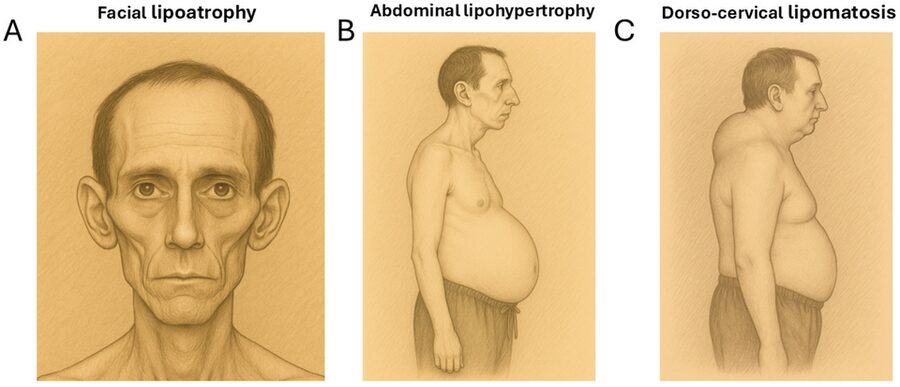

Facial lipoatrophy: the hollowed, skeletonised look of deep facial fat loss
Facial lipoatrophy: the hollowed, skeletonised look of deep facial fat loss. Image: Marta Giralt, Pere Domingo, Tania Quesada-López, Rubén Cereijo, Francesc Villarroya, via Wikimedia Commons (CC BY 4.0).
A woman in her late thirties by a window, hand resting against her cheek, skin even in tone
Assessment comes before any device or injectable is chosen.

Why do cheeks hollow with age?

The face ages as a structure, not a surface. The deep fat compartments — discrete, named pads rather than one continuous layer — deflate unevenly, with the deep medial cheek fat among the earliest. Beneath them, the skeleton remodels: the maxilla and the rims of the orbit and pyriform aperture resorb, so the foundation retreats while the envelope stays the same size. The visible result is indirect: deeper nasolabial folds, a longer lower eyelid, a flatter mid-face. Patients present pointing at the fold; the physician looks at the missing support above it.

Hollow or sagging? The distinction that decides everything

Look at old photographs at the same angle. If your face had the same outline but sat higher, the problem is descent — see jowls and lower face sagging. If the outline itself has narrowed, flattened or emptied — temples, mid-cheek, under-eye — the problem is volume. Most ageing faces carry both, and the order of treatment matters: lifting a deflated face without addressing volume can look tight rather than young — the exact risk unpacked in Ultherapy vs Thermage vs VF Lift vs Time Freeze — and filling a descended face without lifting adds weight in the wrong place. This is why consensus guidance treats toxins, fillers and energy devices as complementary tools in a sequence, not competitors [1].

What actually works for facial volume loss?

Volume can be replaced or regrown. Hyaluronic acid filler restores projection immediately and remains fully reversible with hyaluronidase — a safety property formal guidelines emphasise [2]. Collagen biostimulators rebuild gradually. For patients who prefer no injected product, calibrated energy protocols aim to stimulate the patient's own tissue response — the approach behind the Restore arm of the VF Lift and the dedicated volume restoration page explains the mechanism. Cheek and temple planning is anatomical: support goes where the skeleton retreated, not where the fold shows.

What doesn't work for facial volume loss?

Chasing the nasolabial fold with filler while ignoring the deflated cheek above it treats the shadow, not the object. Overfilling to compensate for descent produces the heavy, rounded look that ends in pillow face. And no topical product restores deep fat or bone — the layers involved are millimetres to centimetres below where skincare acts.

“Volume loss is the ageing nobody names — the folds get blamed while the hollows go unseen.”

— Dr Sin Yong

Dr Sin Yong’s Viewpoint

I ask every volume-loss patient to bring photographs from their twenties. Not for nostalgia — because the face in those photos is the treatment plan. My job is not to build a new face; it is to quietly return the support the years withdrew. When someone leaves my clinic and their friends say they look well-rested rather than 'done', that is the entire aesthetic I practise.

Prefer Not to Use WhatsApp?

Use the short enquiry form instead →

Leave your name, mobile number and email and the clinic will contact you directly. No obligation.

Your details are delivered directly to Dr Sin Yong's clinic team.

Thank you — your enquiry has been received. The clinic will contact you during opening hours (Mon–Fri 10am–8pm, Sat 11am–3pm).

Prefer a preliminary view first? You can also WhatsApp a photo of the area for Dr Sin Yong to review before you decide on a visit.

Which type do you have?

Hollow cheeks and their look-alikes: how each is recognised and what it needs
Type / look-alikeHow to recognise itWhat it needsWhat does not work
Deep fat deflationEmptied or flattened mid-cheek; outline narrower than in old photographsReplace volume, or rebuild support, after assessmentFilling only the fold below the hollow
Bony resorptionRetreating support around the cheekbone, eye socket rim and nose baseSupport planned where the skeleton has retreatedSurface treatments or skincare
Descent look-alikeSame outline as before, but sitting lowerLifting, such as energy-based tightening, sequenced by assessmentFilling a descended face, which adds weight
Weight-loss deflationHollowing after rapid or large weight changeAssessment of volume before choosing replace or rebuildWaiting for volume to return unaided
Under-eye hollowShadow below the lower eyelid from deflated mid-cheek supportMid-cheek support assessed together with the eye areaEye creams, which do not reach deep layers

What does not work, and why

When to see a doctor

Myths we hear in clinic

“Filling the nasolabial fold fixes hollow cheeks.”

The fold is usually the shadow of the cheek above it, so support is planned where the skeleton and fat have retreated.

“A leaner body always means a younger-looking face.”

Rapid or large weight loss deflates the facial fat compartments too, and the face can look older even as the body looks fitter.

Questions Patients Actually Ask

Why do I look tired even when I sleep well?+

Under-eye and mid-cheek volume loss casts static shadows that read as fatigue. Shadow from a hollow does not respond to sleep.

Does losing weight make your face age faster?+

Rapid or large weight loss deflates facial fat compartments along with body fat, and the face can look older even as the body looks fitter.

Are cheek fillers safe?+

In trained hands, hyaluronic acid fillers have a strong safety profile and are reversible with hyaluronidase. Published guidelines exist precisely so complications can be managed and undone.

Can volume come back without filler?+

Volume cannot be wished back, but energy-based protocols can stimulate the patient's own tissue response where indicated — an assessment determines whether you are a candidate.

How do I know if I need lifting or filling?+

Compare old photos at the same angle: same outline sitting lower means lifting; a changed, emptier outline means volume. Most faces need a sequenced combination.

What happens if I do nothing?+

Nothing dangerous. Volume loss is cosmetic, progressive and entirely optional to treat — a fact any honest clinic should tell you.

What causes hollow cheeks?+
Deep midface fat compartments, notably the deep medial cheek fat, deflate unevenly, while the maxilla and the rims of the eye socket and nose opening gradually resorb. The support the skin was draped over retreats. Onset is gradual from the thirties, and rapid weight loss can accelerate it.
Can hollow cheeks be fully reversed?+
Not necessarily fully. Volume can be replaced with filler or a biostimulator, or support rebuilt with energy-based treatment where indicated, but ageing continues and maintenance applies to every approach. An assessment comparing current structure with older photographs decides what is realistic and whether treatment is advised at all.
Which treatment suits hollow cheeks?+
It depends on the dominant problem. Volume loss suits replacing volume or rebuilding support, descent suits lifting, and most faces need a sequence of both. Planning follows where the skeleton and fat have retreated rather than where the fold shows, and your older photographs guide the decision.
How much does hollow cheek treatment cost in Singapore?+
The fee depends on the areas involved, whether volume is replaced or support is rebuilt, the product or device used, and whether treatments are sequenced together. There is no single fee, because the plan follows your structure. A written quote is given at consultation after assessment, and treatment is only advised if it suits you.

References

  1. Consensus Recommendations for Combined Aesthetic Interventions Using Botulinum Toxin, Fillers, and Energy-Based Devices — Dermatologic Surgery (PubMed).
  2. Guideline for the Safe Use of Hyaluronidase in Aesthetic Medicine — Journal of Clinical and Aesthetic Dermatology (PubMed).
  3. Microfocused Ultrasound With Visualization in Skin Quality: A Narrative Review — PMC.

Medically reviewed by Dr Sin Yong, MBBS (NUS), MRCS (Edinburgh) · Last updated 7 October 2026 · Editorial policy

Related reading
Follow Dr Sin Yong
InstagramTikTokYouTubeThreadsXLinkedInFacebook
Printable patient guide (PDF): After your filler treatment — medically reviewed by Dr Sin Yong.
Dr Sin Yong · Every assessment personally performed
WhatsApp Enquiry