Secret RF vs Genius: two approaches to RF microneedling
Medically reviewed by Dr Sin Yong · Last reviewed · 8 min read
Published 9 October 2026 · Reviewed by Dr Sin Yong
Genius, made by Lutronic, is the successor to Infini, one of the earliest microneedle RF systems. Secret RF is made by ILOODA. Both are Korean and both deliver fractional microneedle radiofrequency; they differ most in frequency and in how energy delivery is monitored.
Short answerGenius files bipolar radiofrequency at 460 kHz through a 49-needle array, with depth from 0.5 to 3.5 mm (later filings, 4.0 mm) and real-time impedance sensing described by its maker. Secret RF files bipolar 2 MHz with depth from 0.5 to 3.5 mm in 0.1 mm steps; the Secret DUO adds a 1540 nm fractional laser. Neither has been shown to outperform the other.
Why this site compares devices against Secret RF. Dr Sin Yong is a global Key Opinion Leader for ILOODA’s Secret RF platform and performs RF microneedling personally on the Secret DUO. He has been invited by the manufacturer to share his clinical expertise with doctors internationally. That is a disclosed relationship, so the comparisons on this site stick to what each manufacturer has filed with the US FDA and what published studies measured, and do not rank one device above another.
Secret RF and Genius compared from their FDA 510(k) summaries
Secret RF / Secret DUO (used here)
Genius
Maker
ILOODA Co., Ltd., Korea
Lutronic, Korea (now Cynosure Lutronic)
RF type and frequency
Bipolar, 2 MHz
Bipolar, 460 kHz
Needles
25- and 64-pin; DUO specialty cartridges
49 needles (7×7), 200 µm diameter; further tips in 2026 filing
Real-time impedance sensing, described by the maker as over 500 readings a second
FDA 510(k)
K170325 (2017); DUO K202043 (2021)
K180945 (2018); K253484 (2026)
Published studies found
Split-face RCT in active acne, n=25 (Kwon 2018; device named in a later review)
Periorbital wrinkles in Korean patients, n=11 (Kim 2023)
At this practice
Performed by Dr Sin Yong
Not offered here
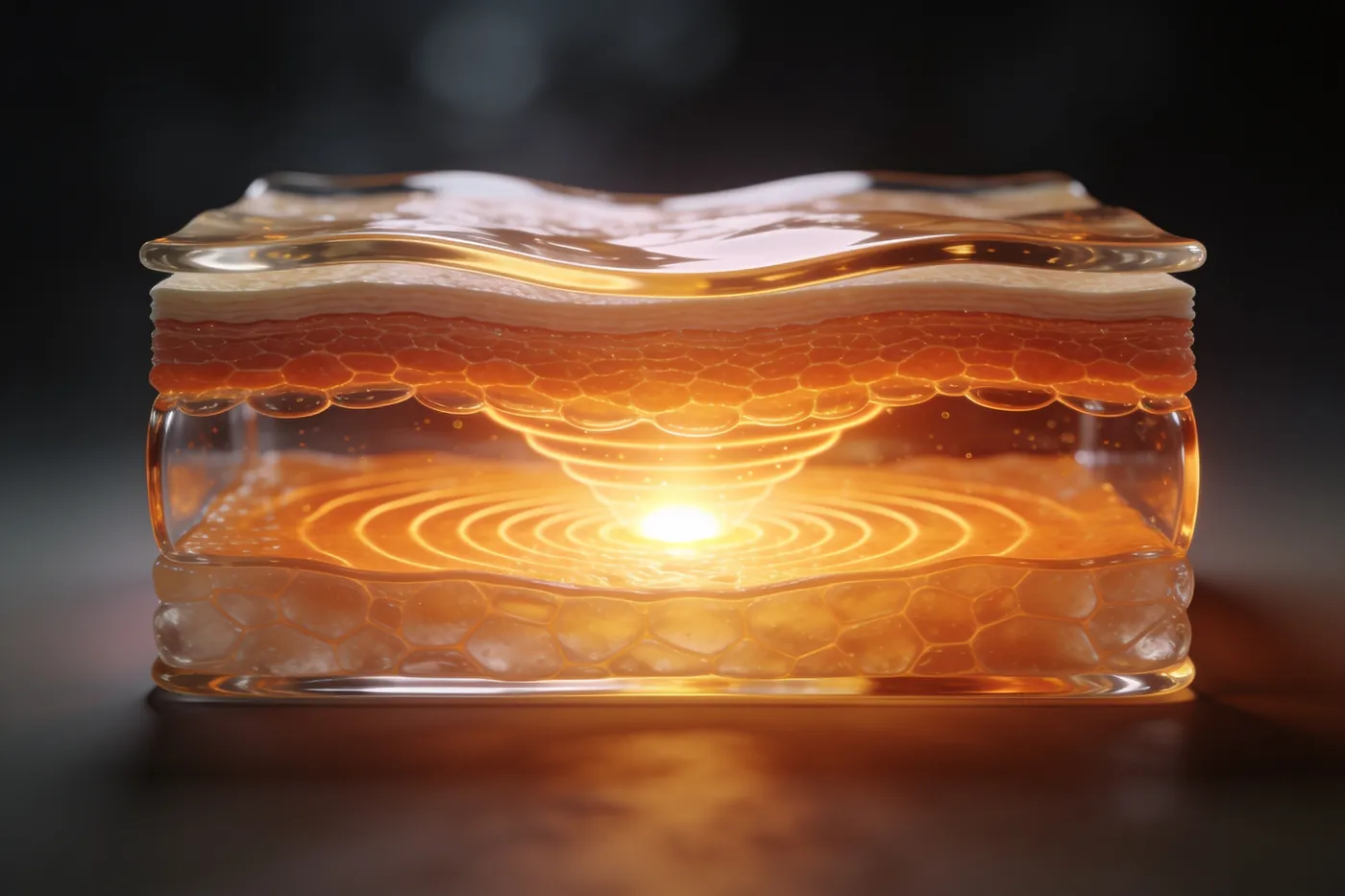
RF microneedling places heat inside the dermis at a depth the doctor sets; the surface is spared when insulated needles are used.Genius files the lowest frequency of the devices compared on this site; Secret RF sits at the upper end, at 2 MHz, with several others.
What does 460 kHz versus 2 MHz mean in practice?
Frequency is one of the factors that shape how radiofrequency heat spreads around a needle. Across the microneedle RF literature, lower frequencies are generally described as producing a broader zone of heating and higher frequencies a more confined one (Chandra, J Cutan Aesthet Surg 2024). Genius files at 460 kHz; Secret RF at 2 MHz. A doctor matches energy, depth and needle type to the target either way, and the frequency is one input to that plan rather than a predictor of result.
What is impedance sensing?
Tissue resists radiofrequency current to differing degrees depending on hydration and structure. Lutronic describes Genius as measuring that resistance, or impedance, over 500 times a second and adjusting delivery in response. That is the manufacturer’s description of the device rather than a measured clinical advantage, and comparative data against devices without it were not found. Secret RF relies on the operator setting depth, energy and sub-pulsing for each zone.
What is the evidence for each?
For Genius, a study of 11 Korean patients treated around the eyes reported improved wrinkle assessment scores and melanin index (Kim, Ann Dermatol 2023). For Secret RF, a split-face randomised trial of 25 Korean patients with acne found greater improvement with microneedle fractional RF than with a 1450 nm diode laser (Kwon, JEADV 2018). Both are small, and neither compares the two devices.
Scar type, depth and skin type decide the plan, whichever device is used.
Which one should you choose?
Choose the doctor and the plan rather than the brand. Both devices deliver fractional microneedle radiofrequency; neither has been shown in a head-to-head trial to outperform the other. Ask which tip will be used, whether its needles are insulated, what depth is planned for each area and why, how energy will be set for your skin type, and who sets those parameters. Ask what RF microneedling will not help, and what would be done for that instead. A tethered scar needs subcision; pigment needs a different tool entirely.
Only the Secret DUO is used at this practice. Dr Sin Yong examines the skin, performs the treatment himself and sets out the plan and fee in writing; how fees are quoted explains why fees are not published.
Frequently Asked Questions
Neither has been shown to outperform the other. Genius files 460 kHz with impedance sensing; Secret RF files 2 MHz with 0.1 mm depth steps, and the Secret DUO adds a 1540 nm fractional laser.
Genius is Lutronic’s successor to Infini. Infini filed at 1 MHz; Genius files at 460 kHz with a 49-needle tip.
No. RF microneedling here is performed on the Secret DUO. Dr Sin Yong is a global Key Opinion Leader for the Secret RF platform.
Around the eyes, the skin is thin and depth is kept conservative on either device. A small Genius study looked at periorbital wrinkles. The plan depends on the eyelid skin, not the brand.
References
US FDA 510(k) summary K170325 — Secret RF (ILOODA Co., Ltd.), 2017: bipolar 2 MHz, needle depth 0.5–3.5 mm in 0.1 mm steps. source
US FDA 510(k) summary K202043 — Secret DUO (ILOODA Co., Ltd.), 2021. source
US FDA 510(k) summary K180945 — Genius (Lutronic), 2018: bipolar 460 kHz; 49 needles; depth 0.5–3.5 mm. source
US FDA 510(k) summary K253484 — Genius (Lutronic), 2026. source
Kim KE, et al. Microneedle RF for periorbital wrinkles in Korean patients (n=11). Ann Dermatol. 2023. doi:10.5021/ad.22.217 (PMID 37830418). source
Kwon HH, et al. Microneedle fractional radiofrequency in acne: a split-face randomised trial versus 1450 nm diode laser in Korean patients. J Eur Acad Dermatol Venereol. 2018. doi:10.1111/jdv.14714 (PMID 29178495). source
Chandra S, et al. Physics of fractional microneedle radiofrequency. J Cutan Aesthet Surg. 2024;17:177. doi:10.25259/jcas_98_23 (PMID 39483649). source
Kumar N, et al. Fractional microneedle radiofrequency: a systematic review of 41 studies with device-level tables. Aesthetic Plast Surg. 2026. doi:10.1007/s00266-026-05834-y (PMID 42047762). source