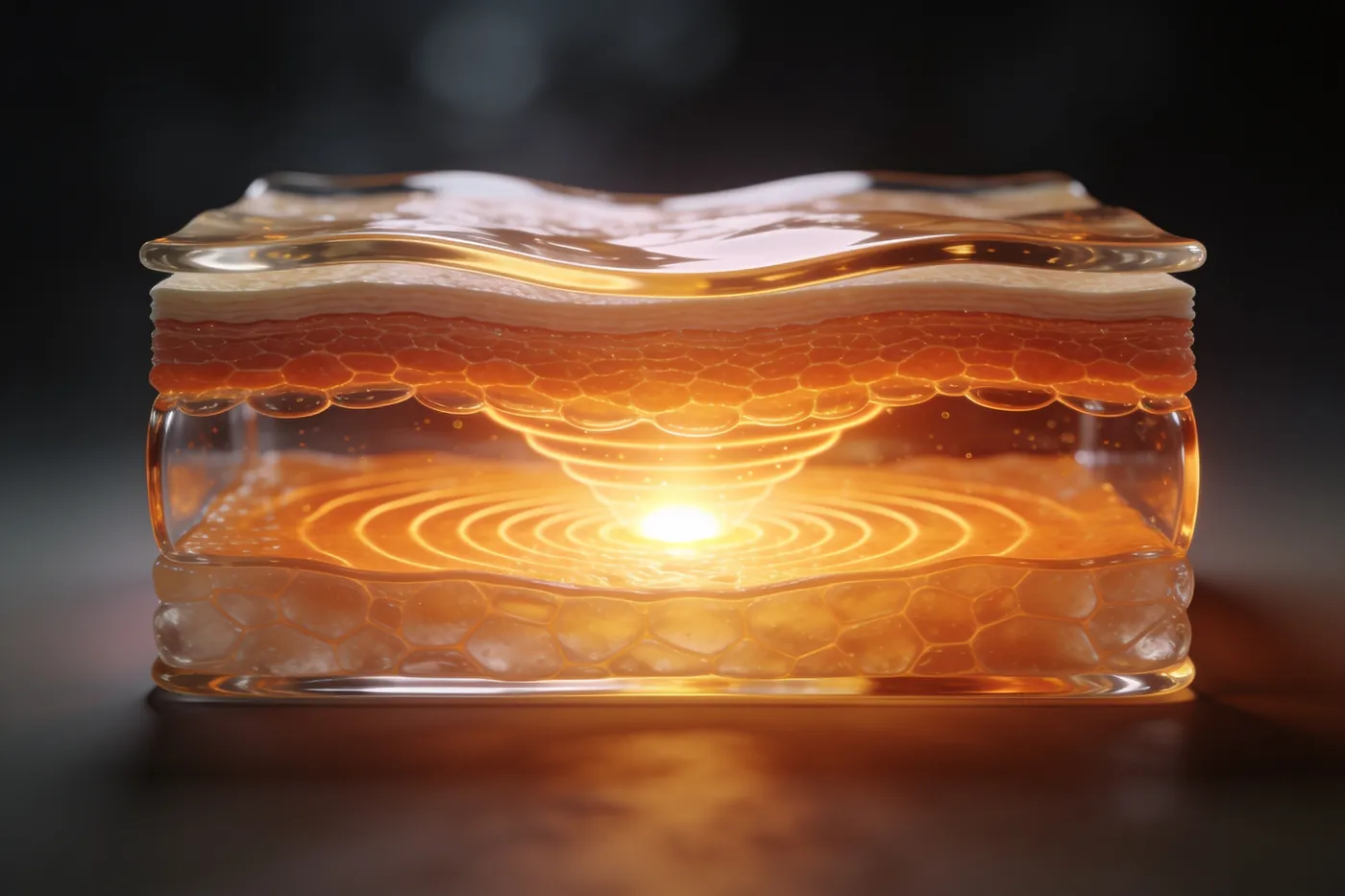
How ultrasound-guided hyaluronidase works: see it, then dissolve only the excess
Medically reviewed by Dr Sin Yong · Last reviewed · 7 min read
Published 10 October 2026 · Reviewed by Dr Sin Yong
Hyaluronidase is the enzyme that breaks down hyaluronic acid filler. Without imaging, the injection relies on surface landmarks and palpation alone. With ultrasound, the filler can be seen before the enzyme is placed. Used with ultrasound, it becomes a targeted procedure. Dr Sin Yong scans the area first, sees where the filler sits, how deep it is and what is next to it, and places the enzyme into the filler itself. This page explains what the scan shows, how the dose is chosen, and why the face is not refilled on the same day.
Short answerUltrasound shows hyaluronic acid filler as a distinct pocket, with its depth and its relationship to vessels. Dr Sin Yong places a small test dose of hyaluronidase into the mapped filler, reviews at about 48 hours, titrates further doses to effect, and waits at least two weeks before any refilling, in line with published guidelines (King 2018; Murray 2021). The aim is to dissolve only the excess; the scan is what makes targeting possible.
The filler pocket, its depth, its size and the vessels beside it
Test dose
A small first dose for non-urgent correction, with a skin test where there is any allergy concern
Review
About 48 hours; further dosing titrated to effect, not a fixed amount
Refilling
Not before two weeks, and never on the same day
Does not work on
Sculptra, Ellansé, Radiesse, PDLLA, fat
Performed by
Dr Sin Yong personally, with the scan done by him in the same visit
Why image before injecting
Hyaluronic acid filler persists far longer than is commonly assumed. MRI studies have found it in the mid-face years after the last injection (Master, Plast Reconstr Surg Glob Open 2024). A lump, a puffy under-eye or an overfilled cheek may be old filler, new filler, fluid, or something that is not hyaluronic acid at all. Ultrasound answers that question in minutes, before anything is injected.
Under the eye the layers are thin, so where the filler sits decides what it looks like and how it is treated. Schematic, not to scale.
What the scan shows
On high-frequency ultrasound hyaluronic acid filler appears as a dark, well-defined pocket. The scan shows how deep it sits (under the skin, in the fat, or on the bone), how large it is, and whether it is one pocket or several. It also shows the vessels next to it, which matters both for the hyaluronidase injection and for any future filler. Biostimulator response and fat look different from HA, which is how a mixed history is sorted out. See the glossary entry.
Depth decides the dose and the needle path.
Dose, test, titrate, wait
The UK guideline on hyaluronidase in aesthetic practice recommends, for non-urgent correction, a small test dose, titration to effect rather than a fixed number of units, review at about 48 hours, and a wait of at least two weeks before any refilling, since the enzyme continues to act and the tissue needs to settle (King, J Clin Aesthet Dermatol 2018). A later guideline adds a modified high-dose protocol for vascular emergencies, which is a different situation entirely (Murray 2021). Dr Sin Yong follows the conservative route for cosmetic correction: enough enzyme to remove the excess he can see, and no more.
Why not dissolve everything?
Blanket dissolving can leave the face hollow and remove filler that was doing its job. With the pocket mapped, the enzyme goes into the excess only. If a hollow remains once the face has settled, it is reassessed after the two-week interval, not refilled on the day. Global consensus on filler complications supports this staged approach (Signorini, Plast Reconstr Surg 2016; Snozzi 2018; Urdiales-Gálvez 2018).
What it cannot do
Hyaluronidase acts only on hyaluronic acid. Sculptra, Ellansé, Radiesse, the PDLLA in Juvelook, and grafted fat are untouched by it. For those, Dr Sin Yong uses Time Freeze Laser LCLR® after mapping; see Ellansé nodules vs Sculptra migration.
Risks
Bruising and swelling at the injection site; over-correction if too much is used, which is why dosing is staged; and, rarely, allergy to the enzyme, which is why a skin test is offered where there is any history of reactions. Vascular compromise after filler is an emergency that uses a different, high-dose protocol and is not what this page describes; if you have skin colour change or pain after filler, seek care immediately.
Fee factors
The number of areas scanned and treated, the number of sessions the titration needs, and whether the scan finds something other than hyaluronic acid. Set out in writing after assessment. How fees are quoted.
Your next step
1. MessageWhatsApp +65 8023 7170 with what is bothering you. A reply comes from the clinic, not a bot.
2. AssessmentDr Sin Yong examines you himself at Wheelock Place, with ultrasound where earlier filler is involved.
3. A plan in writingWhat he would do, what he would not, the fee factors, and the option of no treatment.
Every treatment is performed by Dr Sin Yong personally. Singapore Medical Council registered · invited to share his clinical expertise internationally as a Key Opinion Leader for CLASSYS, DEKA, Fotona, HIRONIC and ILOODA · HSA-registered devices · ultrasound-guided correction
Because it shows where the filler is, how deep, how much, and what is next to it. That lets the enzyme go into the filler rather than across the whole area, so the enzyme is directed at the excess.
For non-urgent correction, a small test dose first, then further doses titrated to effect after review at about 48 hours, in line with published guidelines. No fixed number is used.
Guidelines advise at least two weeks, and Dr Sin Yong does not refill on the same day. The face is reassessed once it has settled.
No. Those products are not hyaluronic acid. Ultrasound still helps, because it shows what the lump is; the treatment for non-HA over-stimulation is Time Freeze Laser LCLR®.
Yes. Dr Sin Yong performs the scan and the injection himself in the same visit at Wheelock Place.
References
King M, Convery C, Davies E. The use of hyaluronidase in aesthetic practice (v2.4). J Clin Aesthet Dermatol. 2018;11(6):E61-E68. PMID 29942426. source
Murray G, Convery C, Walker L, Davies E. Guideline for the safe use of hyaluronidase in aesthetic medicine, including modified high-dose protocol. J Clin Aesthet Dermatol. 2021;14(8):E69-E75. PMID 34840662. source
Master M, Azizeddin A, Master V. Hyaluronic acid filler longevity in the mid-face: a review of 33 magnetic resonance imaging studies. Plast Reconstr Surg Glob Open. 2024;12(7):e5934. doi:10.1097/GOX.0000000000005934. source
Signorini M, Liew S, Sundaram H, et al. Global Aesthetics Consensus: avoidance and management of complications from hyaluronic acid fillers. Plast Reconstr Surg. 2016;137(6):961e-971e. doi:10.1097/PRS.0000000000002184. source
Snozzi P, van Loghem JAJ. Complication management following rejuvenation procedures with hyaluronic acid fillers — an algorithm-based approach. Plast Reconstr Surg Glob Open. 2018;6:e2061. doi:10.1097/GOX.0000000000002061. source