R2T2 Laser Singapore: R2 Glow and T2 Frax Radiance, one plan for pigment, redness and tone
Medically reviewed by Dr Sin Yong · Last reviewed · 9 min read
Published 10 October 2026 · Reviewed by Dr Sin Yong
R2T2 is Dr Sin Yong’s name for running his two tone protocols as one plan. R2 Glow uses long-pulsed 755 nm alexandrite and 1064 nm Nd:YAG energy, with the surface left intact, to calm the low-grade inflammation that keeps melanocytes switched on and leaves a background of redness; in Singapore much of that inflammation is driven by daily ultraviolet exposure. T2 Frax Radiance, on the DEKA TORO, is directed at the pigment already deposited with a 785 nm picosecond pass and adds a longer thermal pulse for a dermal collagen response, which is where its tightening comes from. One works upstream on the driver, the other on the deposit. The balance between them, and whether they run in one session or in sequence, is set at consultation.
Short answerR2T2 combines R2 Glow (anti-inflammatory, long-pulsed 755/1064 nm, surface intact) with T2 Frax Radiance (785 nm picosecond for deposited pigment plus a thermal tightening mode on the DEKA TORO). It is for dull, uneven tone where both a fixed brown deposit and an inflammatory, reddish background are present. Melasma is assessed separately and usually starts with R2 Glow or no laser. Dr Sin Yong examines the skin first and performs every pass himself.
Long-pulsed 755 nm alexandrite + 1064 nm Nd:YAG; non-ablative; directed at low-grade inflammation and background redness
T2 Frax Radiance
DEKA TORO: 785 nm picosecond for pigment, 532/1064 nm nanosecond, plus a thermal mode for collagen and tightening
Built for
Dull, uneven tone with both a fixed deposit and an inflammatory background; Fitzpatrick III–V
Sequence
Same session or staged, R2 usually first when the skin is reactive; decided at consultation
Not for
Active melasma as a first step; tanned or recently sun-exposed skin; active infection; recent isotretinoin
Fee
Set out in writing after assessment; see how fees are quoted
Why two lasers, and why in this order
A brown mark on the face has two parts: the pigment that is already sitting in the skin, and whatever keeps the melanocytes producing more of it. On a Singapore face the second part is usually low-grade inflammation, much of it from year-round ultraviolet exposure, and it shows as a reddish, slightly dull background that makes the whole tone look uneven. Clearing the deposit without calming the driver tends to give a short-lived result; calming the driver without clearing the deposit leaves the fixed marks in place. R2T2 is simply the decision to treat both.
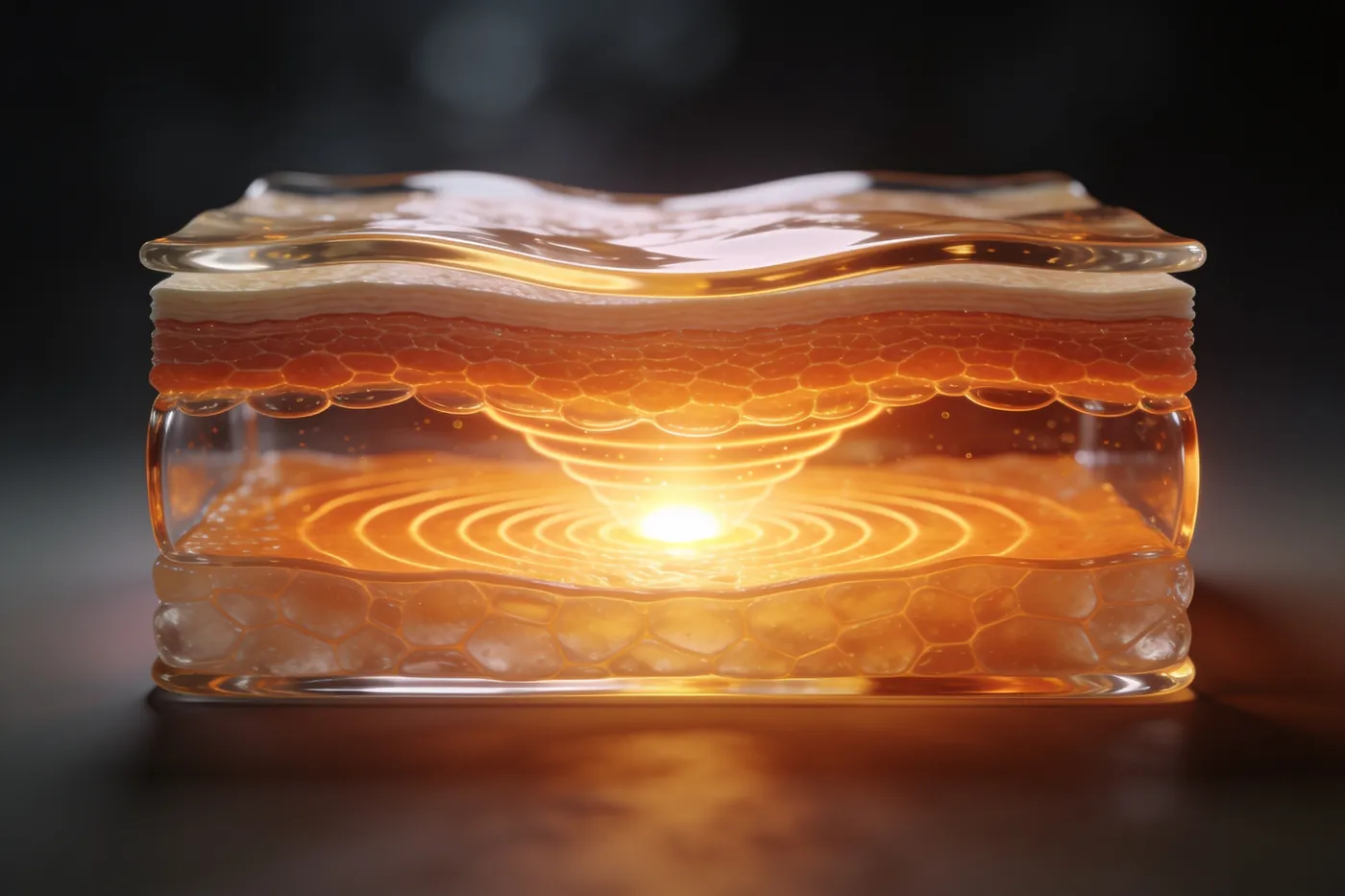
R2 Glow works upstream on the inflammatory driver; T2 Frax Radiance works on the deposit and adds a thermal pass. Schematic, not to scale.
R2: the driver
R2 Glow runs long-pulsed 755 nm alexandrite and 1064 nm Nd:YAG energy at parameters chosen for inflammation rather than for pigment, with the epidermis left intact. The 1064 nm wavelength in a long pulse has the longest published record against facial redness: in a series of 66 rosacea patients, long-pulsed Nd:YAG gave good-to-excellent responses in roughly half, with the erythematous subtype responding better than the papulopustular one (Mese Say, J Clin Aesthet Dermatol 2015). Because R2 acts on a process rather than a deposit, its effect accumulates over a course rather than appearing after one pass. Full page: R2 Glow Laser.
R2 Glow is the slow half of the plan: it works on what keeps producing the pigment.
T2: the deposit, then tighten
T2 Frax Radiance is Dr Sin Yong’s pico laser protocol on the DEKA TORO. Its 785 nm picosecond pulse is over before meaningful heat can spread, so pigment is fragmented by a pressure wave rather than cooked; that photoacoustic mechanism is why picosecond delivery is the safer choice for Fitzpatrick III–V skin, where thermal load risks post-inflammatory hyperpigmentation (Torbeck, Dermatol Surg 2019; Chan, Lasers Surg Med 2016). The second half of the protocol uses the platform’s longer thermal pulse for a dermal collagen response; histology after fractional picosecond treatment shows the small intra-epidermal and dermal injury zones that drive that remodelling (Tanghetti, Lasers Surg Med 2016). That collagen pass is the tightening component of R2T2. Full page: T2 Frax Radiance.
The thermal pass works in the dermis; the picosecond pass works on the pigment above it.
How a session is planned
How R2T2 is sequenced
What the examination shows
Usual order
Why
Fixed brown marks on calm skin
T2 first, R2 to maintain
The deposit is the main problem; R2 keeps the driver quiet afterwards
Reactive, reddish skin with scattered marks
R2 first, T2 once the skin is calmer
Treating pigment over active inflammation raises the PIH risk
Both, in roughly equal measure
Same session: R2 pass, then T2
Different wavelengths and pulse widths, no overlap in target
Melasma
R2 Glow or no laser first
Melasma rebounds with heat; picosecond toning only as a conservative adjunct once stable
Tanned or recently sun-exposed skin
Wait
More melanin in the epidermis absorbs stray energy
What R2T2 does not do
It does not shrink pores or stop oil production; it changes how pores look through tone and collagen.
It does not clear melasma on its own, and it is not started on active melasma.
It does not replace sunscreen; without daily protection the driver returns.
Risks and side effects
Transient redness and warmth for hours to a day or two are usual. The specific risk in darker skin types is post-inflammatory hyperpigmentation, which is why the picosecond pass is used for pigment and the thermal pass is kept conservative (Syder, Dermatol Surg 2023). Rebound darkening is the known risk in melasma, which is why melasma is handled differently. Blistering and pale spots are rare and are the reason settings are tested on a small area first. Any blister, open skin, or darkening that spreads should be reported the same day.
Aftercare
Sunscreen every morning, reapplied if outdoors; no exfoliating acids or retinoids for a few days; no sauna, heavy exercise or sun exposure on the day. Make-up can usually be worn the next day. The exact instructions are given in writing after the session.
What decides the fee
Whether one or both protocols are needed, how many passes, the area treated, and the number of sessions the examination suggests. Singapore’s healthcare advertising rules do not allow a clinic to publish prices, so the fee is set out in writing after assessment; how fees are quoted explains what moves it.
Your next step
1. MessageWhatsApp +65 8023 7170 with what is bothering you. A reply comes from the clinic, not a bot.
2. AssessmentDr Sin Yong examines you himself at Wheelock Place, with ultrasound where earlier filler is involved.
3. A plan in writingWhat he would do, what he would not, the fee factors, and the option of no treatment.
Every treatment is performed by Dr Sin Yong personally. Singapore Medical Council registered · invited to share his clinical expertise internationally as a Key Opinion Leader for CLASSYS, DEKA, Fotona, HIRONIC and ILOODA · HSA-registered devices · ultrasound-guided correction
R2T2 is Dr Sin Yong's combined laser plan: R2 Glow, a non-ablative long-pulsed 755 nm and 1064 nm protocol directed at low-grade inflammation and redness, with T2 Frax Radiance, a 785 nm picosecond pigment pass plus a thermal tightening pass on the DEKA TORO. It is used when a face has both deposited pigment and an inflammatory, reddish background.
It can be, with the R2 pass first and the T2 pass after, because the two use different wavelengths and pulse widths. When the skin is reactive, R2 Glow runs first over a few visits and T2 is added once the skin is calmer. The order is set at consultation.
The T2 half includes a longer thermal pulse for a dermal collagen response, which is where a mild tightening effect comes from. It is a skin-quality effect, not a lift; descended jowls or neck laxity are treated with VF Lift or Time Freeze Laser LCLR®.
Not as a first step. Melasma rebounds with heat, so it usually starts with R2 Glow or no laser at all, and picosecond toning is added only conservatively once it is stable.
The protocol is built for Fitzpatrick III to V. The picosecond pass fragments pigment with a pressure wave rather than heat, which lowers the post-inflammatory hyperpigmentation risk that thermal pigment lasers carry in darker skin. Settings are tested on a small area first, and tanned skin is asked to wait.
The examination decides. R2 Glow works on a process and accumulates over a course; T2 Frax Radiance works on a deposit and the number of passes depends on how much pigment is present. No fixed number is sold in advance.
References
Torbeck RL, Schilling L, Khorasani H, Dover JS, Arndt KA, Saedi N. Evolution of the picosecond laser: a review of literature. Dermatol Surg. 2019;45(2):183-194. doi:10.1097/DSS.0000000000001697. source
Chan JC, Shek SY, Kono T, Yeung CK, Chan HH. A retrospective analysis on the management of pigmented lesions using a picosecond 755-nm alexandrite laser in Asians. Lasers Surg Med. 2016;48(1):23-29. doi:10.1002/lsm.22443. source
Tanghetti EA. The histology of skin treated with a picosecond alexandrite laser and a fractional lens array. Lasers Surg Med. 2016;48(7):646-652. doi:10.1002/lsm.22540. source
Mese Say E, Okan G, Gökdemir G. Treatment outcomes of long-pulsed Nd:YAG laser for two different subtypes of rosacea (n=66). J Clin Aesthet Dermatol. 2015;8(9):16-20. source
Syder NC, Chen A, Elbuluk N. Radiofrequency microneedling in skin of colour: a review of 35 studies. Dermatol Surg. 2023;49:489. doi:10.1097/DSS.0000000000003733. source